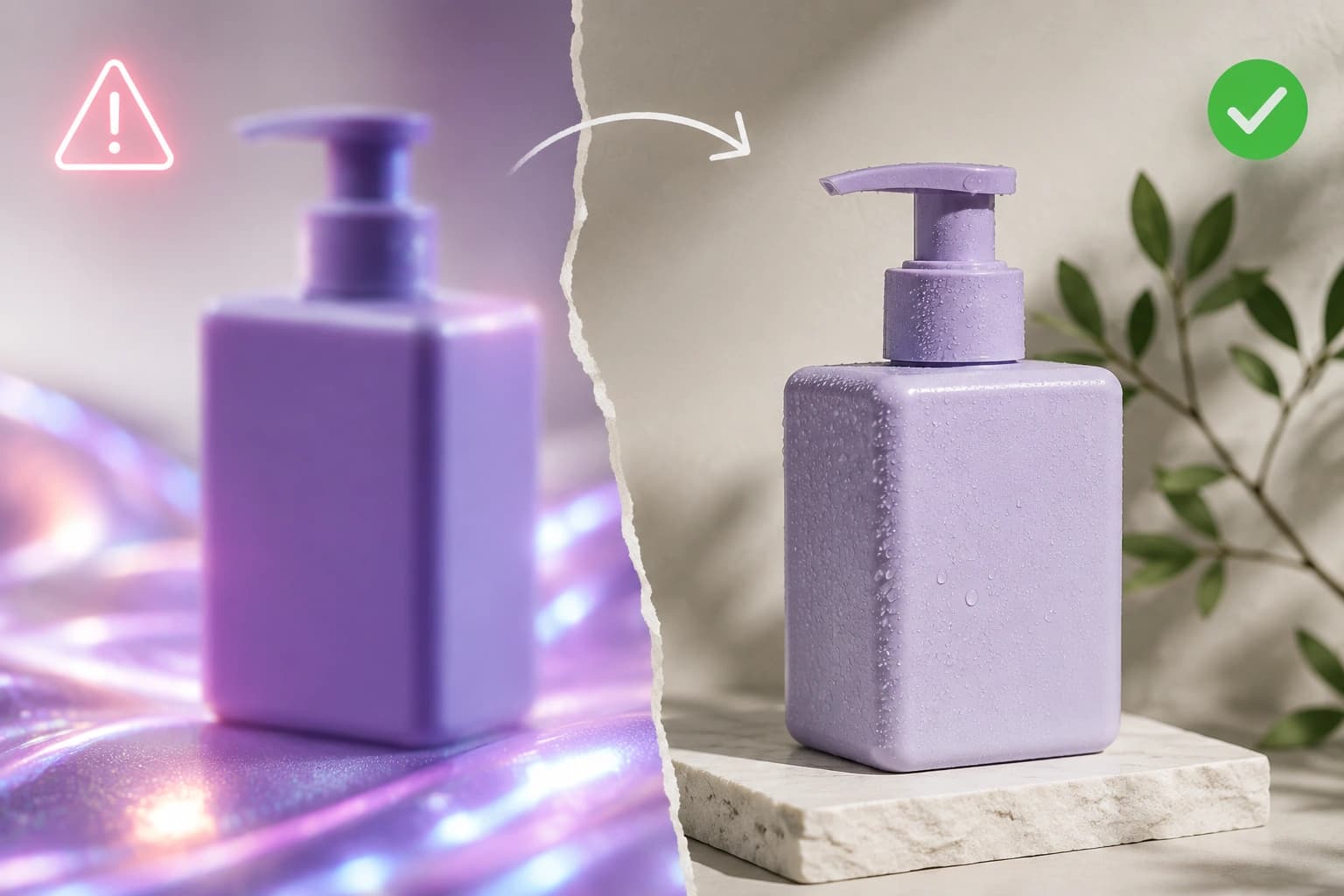
What Is Product Fidelity?
If you’ve ever uploaded a product into an AI image generator and received an image where the logo changed, the label became unreadable, the bottle shape looked different, or the product color shifted slightly, you’ve experienced a product fidelity problem.
Product fidelity refers to how accurately an AI-generated image preserves every important characteristic of the original product.
That includes:
- Logo placement
- Brand typography
- Packaging dimensions
- Product shape
- Material texture
- Colors
- Surface finish
- Labels
- Printing
- Transparent areas
- Reflective surfaces
- Small design elements
- Stitching
- Engravings
- Gemstones
- Fabric patterns
A product image can look visually stunning while still having poor product fidelity.
For ecommerce brands, fidelity matters more than aesthetics.
A beautiful image that misrepresents the product can damage trust faster than an average image that accurately reflects what customers receive.
Why Product Fidelity Matters More Than Ever
Five years ago, brands primarily evaluated product photos based on lighting, composition, and overall visual appeal.
Today, AI has made it possible to generate studio-quality scenes in seconds.
The challenge has shifted.
Instead of asking:
“Can AI make beautiful product photos?”
Brands are now asking:
“Can AI make beautiful product photos without changing my product?“
That difference is enormous.
Consumers expect the item arriving at their doorstep to match the product they saw online.
Even subtle inconsistencies can lead to:
- Lower conversion rates
- Customer complaints
- Increased returns
- Negative reviews
- Loss of brand trust
- Marketplace policy issues
As AI-generated content becomes mainstream, customers are becoming better at spotting inaccurate product images.
Ironically, the more realistic AI becomes, the more important authenticity becomes.
The Trust Equation
Successful ecommerce isn’t just about attractive visuals.
It’s about creating confidence.
Every product image communicates:
- What the customer will receive
- Whether the brand is trustworthy
- Whether the product looks premium
- Whether the product matches expectations
If an AI tool accidentally changes the shade of a cosmetic bottle, removes stitching from clothing, alters jewelry stones, or invents label text, customers notice.
Even when they cannot immediately identify the change, something feels “off.”
That subconscious loss of trust directly impacts purchasing decisions.
Modern ecommerce brands increasingly prioritize accuracy over creativity when generating product images.
Why Most AI Product Photography Tools Fail Product Fidelity
This is where many AI tools fall short.
Most image generation models were never designed specifically for ecommerce.
Instead, they were trained to create new images from patterns learned across billions of internet images.
Their objective isn’t to preserve an existing object perfectly.
Their objective is to create something that looks plausible.
That distinction explains nearly every product fidelity issue.
Imagine uploading a perfume bottle.
The AI doesn’t think:
“I’ll keep this exact bottle and change the background.”
Instead, it often thinks:
“I know what perfume bottles generally look like.”
Then it reconstructs a new version based on its learned representation.
The reconstructed bottle may appear nearly identical—but not identical enough for ecommerce.
AI Doesn’t Copy Your Product – It Reimagines It
This is perhaps the biggest misconception surrounding AI product photography.
Most users assume AI edits an existing photograph.
In reality, many AI systems generate an entirely new image influenced by the original.
Think of it like an artist painting your product from memory instead of photographing it.
The artist remembers:
- roughly the shape
- roughly the colors
- roughly the lighting
But small details inevitably drift.
For artistic photography, that’s acceptable.
For ecommerce, it’s a problem.
Understanding Diffusion Models (Without the Math)
Most modern AI image generators are based on diffusion models.
A simplified view of the process:
- The model starts from random visual noise.
- It gradually removes that noise over many steps.
- During each step, it predicts what the image should look like.
- Conditioning inputs (such as your uploaded photo and text prompt) guide this prediction.
- The final image emerges from those predictions.
At no point is the original photograph simply “copied.”
Instead, the AI continuously predicts pixels that appear statistically correct.
This prediction process introduces small deviations.
Those deviations accumulate across hundreds of generation steps.
That’s why:
- logos shift
- corners become rounded
- reflections change
- colors drift
- labels blur
- edges soften
- text becomes distorted
The AI isn’t intentionally changing the product.
It’s simply optimizing for realism—not exact identity.
The “Looks Right” Problem
Humans judge products differently than AI.
When people shop online, they inspect tiny details:
- stitching on handbags
- gemstone placement
- bottle caps
- metallic finishes
- embroidery
- zipper positions
- logo embossing
- packaging edges
AI, however, optimizes for overall visual plausibility.
If the image appears convincing from a distance, the model considers it successful.
That difference creates the “looks right” problem.
An image may appear perfect in a social media feed yet contain dozens of inaccuracies that become obvious when customers zoom in.
Product Fidelity Is Harder Than It Looks
Preserving an object’s identity is one of the most difficult problems in generative AI.
Unlike portraits, landscapes, or illustrations, products often have:
- geometric precision
- symmetry
- printed text
- exact colors
- brand-specific typography
- manufacturing tolerances
- reflective materials
- transparent surfaces
- fine engravings
Each characteristic introduces another opportunity for the AI to drift from reality.
The more premium the product, the more noticeable those deviations become.
A luxury watch, engagement ring, designer handbag, or skincare bottle leaves almost no room for error.
Common Product Fidelity Failures
Across thousands of AI-generated ecommerce images, the same mistakes appear repeatedly.
1. Logos Change
Brand logos become stretched, incomplete, blurry, or replaced with invented symbols.
2. Text Becomes Gibberish
Small labels remain one of the hardest challenges for image generation models.
Ingredients, product names, and descriptions frequently become unreadable.
3. Colors Drift
A black product becomes charcoal.
Rose gold becomes yellow gold.
Ivory becomes white.
These subtle shifts can create customer disappointment.
4. Materials Change
Leather suddenly resembles plastic.
Matte finishes become glossy.
Metal appears painted.
Fabric textures disappear.
5. Product Shape Changes
Corners become rounded.
Bottle caps shrink.
Packaging proportions shift.
Objects become thicker or thinner than reality.
6. Fine Details Disappear
Jewelry prongs.
Watch engravings.
Button stitching.
Tiny gemstones.
Thread patterns.
These are often simplified during generation.
Why This Matters for Ecommerce Brands
Every product image serves as a promise.
The closer the delivered product matches that promise, the stronger customer trust becomes.
When AI introduces inaccuracies—even beautiful ones—that promise weakens.
For ecommerce businesses competing in crowded markets, trust is often the deciding factor between a sale and an abandoned cart.
And as AI becomes a standard part of product photography workflows, product fidelity is emerging as the new benchmark for quality—not just realism.
How Poor Product Fidelity Hurts Ecommerce Businesses
Many brands assume that if an AI-generated product photo looks “good enough,” customers won’t notice minor differences. In reality, shoppers are incredibly detail-oriented—especially when they’re spending money on products they can’t physically inspect.
A customer may not consciously identify that a product image is inaccurate, but they can often sense that something feels off. This subtle hesitation can reduce confidence, increase friction during the buying process, and ultimately lower conversions.
Product fidelity isn’t just a design concern—it’s a business metric.
The Real Cost of Inaccurate AI Product Images
When AI modifies important product details, the consequences can include:
- Lower click-through rates from search results or ads
- Reduced conversion rates on product pages
- Increased product returns
- More customer support inquiries
- Negative reviews mentioning the product “looked different”
- Lower repeat purchase rates
- Damage to long-term brand trust
For established ecommerce brands, trust is one of the most valuable assets. Every product image should reinforce that trust—not weaken it.
Why Product Fidelity Matters Across Different Industries
Not every product category has the same tolerance for visual inaccuracies.
A slight background change may be acceptable.
A product change usually isn’t.
Let’s look at how fidelity impacts different industries.
Jewelry: Tiny Details, Huge Expectations
Jewelry is one of the most demanding categories for AI product photography.
Customers often zoom into product images to inspect:
- Stone clarity
- Gem placement
- Prong settings
- Engravings
- Metal finish
- Chain thickness
- Clasp design
- Surface polish
Even a tiny change can alter the perceived value of the product.
For example:
- A four-prong diamond ring becomes six-prong.
- A rose gold necklace appears yellow gold.
- Pavé stones disappear.
- The pendant becomes slightly larger.
- Metal reflections look like plastic.
These differences may seem insignificant to an AI model, but they matter enormously to buyers comparing premium jewelry.
For jewelry brands, preserving product identity should always take priority over creating dramatic backgrounds.
Fashion & Apparel: Consistency Sells
Fashion photography introduces a different challenge.
AI often struggles with:
- Fabric texture
- Stitching
- Button placement
- Sleeve length
- Collar shape
- Prints and patterns
- Embroidery
- Fit and silhouette
Imagine selling a linen shirt.
If the AI smooths the natural weave into a synthetic-looking fabric, customers may perceive the garment differently.
Similarly, changing the shade of denim or altering the placement of a pocket can create confusion when the delivered product doesn’t match the listing.
Fashion brands also rely heavily on visual consistency across collections. Product pages, lookbooks, and advertising campaigns should present a unified style without changing the products themselves.
Cosmetics & Beauty: Color Accuracy Is Everything
Beauty products depend on precision.
A lipstick shade that appears warmer than reality can lead to disappointment.
A skincare bottle with an altered label can reduce trust.
AI commonly struggles with:
- Packaging reflections
- Transparent bottles
- Frosted glass
- Metallic caps
- Printed ingredients
- Shade accuracy
- Pump dispensers
- Dropper bottles
Customers purchasing cosmetics often compare products side by side.
Small color shifts can influence purchasing decisions, especially when choosing foundation, concealer, nail polish, or lipstick.
Maintaining accurate colors isn’t just good practice—it’s essential for customer satisfaction.
Electronics: Precision Builds Credibility
Electronics buyers expect exact specifications.
Visual inaccuracies can immediately reduce confidence.
Common AI issues include:
- Missing ports
- Incorrect button layouts
- Altered camera modules
- Screen reflections
- Logo placement
- Speaker grilles
- Charging connectors
Imagine advertising a wireless speaker where the AI accidentally removes a USB-C port or changes the arrangement of controls.
Even if the product still looks premium, tech-savvy customers will notice.
Home & Lifestyle Products
Products like kitchenware, furniture, candles, décor, and storage items often rely on subtle material characteristics.
AI can unintentionally modify:
- Wood grain
- Marble patterns
- Ceramic glaze
- Glass transparency
- Fabric weave
- Cushion texture
- Surface finish
These changes influence how premium a product appears.
For handcrafted or artisan products, preserving those natural imperfections is often part of the brand story.
Why Customers Notice More Than You Think
Modern shoppers don’t simply glance at product images.
They zoom.
They compare.
They swipe between competitors.
They inspect details before purchasing.
Research in ecommerce consistently shows that high-quality visuals increase buyer confidence, but those visuals must also accurately represent the product. An attractive image that misrepresents reality may create an initial click, yet it can also lead to dissatisfaction, returns, and lost trust after purchase.
As AI-generated content becomes more common, customers are becoming increasingly skilled at spotting inconsistencies.
Ironically, the better AI becomes at producing photorealistic scenes, the more important product accuracy becomes.
Marketplace Policies Make Accuracy Even More Important
Major ecommerce marketplaces expect sellers to accurately represent the products they sell.
While policies differ across platforms, they generally require product images to avoid misleading buyers.
If AI changes important product characteristics, sellers risk:
- Customer complaints
- Listing suppression
- Increased return rates
- Manual review requests
- Loss of trust signals
For brands selling across multiple marketplaces, maintaining accurate product imagery is becoming a competitive necessity rather than just a creative preference.
Why Traditional AI Image Generators Often Fall Short
General-purpose AI image generators are built to maximize creativity.
That’s exactly why they’re excellent at creating:
- fantasy scenes
- concept art
- landscapes
- portraits
- illustrations
- marketing visuals
But ecommerce product photography requires a very different objective.
Instead of asking:
“Generate a beautiful product.”
The real goal is:
“Preserve this exact product while changing everything around it.”
That subtle difference fundamentally changes how the AI system should operate.
The Difference Between Generating and Preserving
Many AI tools excel at generation.
Far fewer excel at preservation.
Think of it this way.
Generation-first workflow
Original Product
        ↓
AI rebuilds product
        ↓
Beautiful new scene
The product may look similar, but important details can change.
Fidelity-first workflow
Original Product
        ↓
Product identity preserved
        ↓
Background, lighting, props and composition transformed
Here, the product remains the same while the surrounding environment evolves.
For ecommerce, the second approach is significantly more reliable.
What Modern AI Systems Do Differently
The latest generation of AI product photography platforms is moving away from “recreating” products and toward preserving them.
Instead of relying on a single text prompt, advanced workflows combine multiple techniques, such as:
- High-quality product segmentation to isolate the item from its background.
- Multi-image conditioning so the model has more visual information about the product.
- Identity-preserving guidance to keep shapes, colors, and branding consistent.
- Region-aware editing that modifies only selected parts of the image.
- Background replacement instead of full image regeneration.
- Detail refinement steps to maintain textures, reflections, and edges.
- Quality-control checks that flag obvious inconsistencies before export.
The goal isn’t simply to produce a beautiful image.
It’s to produce one that a customer can trust.
Product Fidelity Should Be Measurable
As AI photography matures, brands should begin evaluating tools using fidelity-focused questions instead of relying solely on visual appeal.
Consider asking:
- Does the logo remain identical?
- Are the colors consistent with the original product?
- Does the packaging maintain its exact proportions?
- Is text still readable?
- Are reflections natural rather than distorted?
- Have materials retained their original appearance?
- Would a customer immediately recognize this as the same product?
These questions help shift the conversation from aesthetics to accuracy.
A Better Way to Evaluate AI Product Photography Tools
When comparing AI photography platforms, avoid choosing the one with the most dramatic examples.
Instead, compare how well each platform preserves the original product across multiple generations.
A reliable workflow should consistently maintain:
- Brand identity
- Product dimensions
- Labels and typography
- Materials and finishes
- Fine details
- Color accuracy
- Overall visual consistency
For ecommerce brands producing hundreds or thousands of images, consistency is often more valuable than creativity.
How to Maintain Product Fidelity in AI Product Photography (Best Practices for 2026)
As AI image generation continues to evolve, preserving product fidelity is no longer a luxury—it’s a competitive advantage. Brands that consistently produce accurate, trustworthy product images are more likely to earn customer confidence, reduce returns, and build long-term loyalty.
Whether you’re creating ten images a month or managing a catalog of thousands of SKUs, the following best practices will help you achieve more reliable results.
1. Start With High-Quality Product Photos
AI can only preserve details that are visible in the original image.
If your source photo is blurry, poorly lit, or compressed, the AI has less information to work with.
For the best results:
- Use natural or studio lighting.
- Keep the product in sharp focus.
- Capture the highest resolution available.
- Avoid heavy compression.
- Photograph the entire product without cropping important details.
Think of the original image as the foundation for everything that follows.
2. Use Multiple Reference Images When Possible
One image only shows one perspective.
Multiple angles help AI better understand:
- Product proportions
- Shape
- Materials
- Logos
- Surface details
- Colors
This is especially valuable for products with reflective surfaces, transparent packaging, or intricate designs.
3. Preserve the Product—Only Change the Environment
One of the biggest mistakes brands make is asking AI to regenerate the entire image.
Instead, the goal should be:
- Keep the product identical.
- Replace the background.
- Improve lighting.
- Add realistic shadows.
- Introduce props only if they don’t obscure the product.
The product itself should remain untouched.
4. Verify Every Image Before Publishing
Even the best AI systems can occasionally introduce small inaccuracies.
Before uploading an image to your ecommerce store, compare it with the original.
Check:
- Logo placement
- Colors
- Packaging
- Shape
- Materials
- Labels
- Product size
- Fine details
A quick review can prevent costly mistakes later.
5. Be Careful With Text
AI image models have improved dramatically, but small typography remains challenging.
Always inspect:
- Product names
- Ingredients
- Labels
- Warning text
- Barcodes
- Certifications
- Brand marks
If text looks distorted or inaccurate, use the original packaging instead of relying on AI to recreate it.
6. Maintain Consistency Across Your Catalog
Customers expect a cohesive shopping experience.
Use the same:
- Lighting style
- Camera angle
- Background aesthetic
- Shadow direction
- Image dimensions
- Composition
Consistency helps build a stronger brand identity while making your catalog look more professional.
7. Test on Real Customers
Don’t assume an image is accurate simply because it looks good.
Ask colleagues or customers:
- Does this look like the real product?
- Would anything here surprise you after delivery?
- Does the material appear authentic?
- Does the packaging match reality?
Fresh eyes often catch details that creators overlook.
8. Use AI as an Enhancement Tool, Not a Replacement for Accuracy
The most effective workflows combine traditional product photography with AI enhancements.
Instead of inventing products, AI should:
- Improve presentation
- Create lifestyle scenes
- Expand creative possibilities
- Generate marketing assets
- Save production time
The product itself should remain the source of truth.
9. Choose AI Tools Designed for Ecommerce
General-purpose image generators prioritize creativity.
Dedicated ecommerce solutions prioritize:
- Product preservation
- Consistency
- Catalog scalability
- Commercial use
- Accurate editing
When evaluating software, look beyond the visual quality of a single example. Test how consistently the tool preserves your product across multiple generations.
10. Build a Repeatable Workflow
Successful brands don’t rely on luck.
Create a documented workflow that includes:
- Capture the original product.
- Remove the background if needed.
- Generate AI variations.
- Compare against the original.
- Review internally.
- Publish.
- Monitor customer feedback.
Consistency in process leads to consistency in results.
Product Fidelity Checklist
Before publishing any AI-generated product image, ask yourself:
✅ Does the logo exactly match the original?
✅ Are all labels readable?
✅ Is every color accurate?
✅ Has the product shape remained unchanged?
✅ Are textures realistic?
✅ Are reflections natural?
✅ Does the packaging match the real product?
✅ Would the customer receive exactly what they see?
If the answer to any of these questions is “no,” revise the image before publishing.
Comparing AI Product Photography Approaches
| Feature | Traditional AI Image Generator | Fidelity-Focused AI Workflow |
|---|---|---|
| Product identity | Frequently changes | Preserved |
| Logo accuracy | Inconsistent | High priority |
| Text quality | Often distorted | Original packaging retained where possible |
| Color consistency | May drift | Closely matched |
| Brand consistency | Variable | Designed for catalog consistency |
| Ecommerce suitability | Limited | High |
| Marketplace readiness | Requires careful review | Better aligned with commercial workflows |
Where Monoshoot Fits In
As ecommerce brands adopt AI product photography, the challenge is no longer creating attractive visuals—it’s creating attractive visuals that remain faithful to the original product.
Monoshoot is built around that philosophy.
Rather than treating products as objects to be recreated, the workflow is designed to preserve product identity while transforming the surrounding scene. This allows brands to generate studio-quality lifestyle images, marketplace photos, and marketing creatives without intentionally altering the product itself.
No AI system is perfect, and every generated image should still be reviewed before publication. However, ecommerce-focused workflows that prioritize fidelity are generally better suited to commercial product photography than general-purpose image generators designed primarily for artistic creation.
Frequently Asked Questions
What is product fidelity in AI product photography?
Product fidelity refers to how accurately an AI-generated image preserves the original product’s shape, colors, materials, labels, logos, and other defining characteristics while modifying the surrounding scene.
Why do AI-generated product images sometimes look different from the original?
Many AI models generate new pixels based on learned patterns rather than directly editing the original image. This can introduce subtle changes in packaging, colors, textures, or proportions.
Can AI accurately preserve logos and branding?
Modern AI systems have improved significantly, but logos and fine typography remain challenging. Images should always be reviewed before commercial use.
Is product fidelity important for ecommerce?
Yes. Accurate product images help build trust, reduce returns, improve customer satisfaction, and better represent the item customers will receive.
Should AI-generated product photos be used on marketplaces?
They can be, provided the images accurately represent the product and comply with each marketplace’s image requirements. Sellers should review generated images carefully before publishing.
Can AI replace traditional product photography?
AI is increasingly becoming a powerful complement to traditional photography. For many ecommerce use cases, it can significantly reduce production time while expanding creative possibilities, provided product accuracy is maintained.
Key Takeaways
Product fidelity is rapidly becoming one of the defining standards for AI product photography.
As AI-generated imagery becomes commonplace, brands will increasingly compete not just on creativity, but on authenticity.
The most successful ecommerce businesses will be those that combine the speed and flexibility of AI with the precision customers expect from professional product photography.
In 2026, beautiful images are no longer enough.
Customers expect images that are both visually compelling and genuinely representative of the products they purchase.
Brands that prioritize product fidelity today will be better positioned to earn trust, reduce returns, and scale their visual content with confidence.
Product fidelity is rapidly becoming one of the defining standards for AI product photography.
As AI-generated imagery becomes commonplace, brands will increasingly compete not just on creativity, but on authenticity.
The most successful ecommerce businesses will be those that combine the speed and flexibility of AI with the precision customers expect from professional product photography.
In 2026, beautiful images are no longer enough.
Customers expect images that are both visually compelling and genuinely representative of the products they purchase.
Brands that prioritize product fidelity today will be better positioned to earn trust, reduce returns, and scale their visual content with confidence.
References
To ensure accuracy and align with current research and industry guidance, consider linking to authoritative sources such as:
- OpenAI – GPT Image API Documentation
- OpenAI – Introducing GPT-Image-1
- Stability AI – Stable Diffusion Documentation
- Google DeepMind – Imagen Research
- Adobe Firefly
- Amazon Seller Central – Product Image Requirements
- Shopify – Product Photography Tips
- Baymard Institute – Product Page UX Research
- NVIDIA Research – Generative AI Publications
- CVPR (Computer Vision Foundation Proceedings)
- arXiv – Computer Vision & Pattern Recognition
- Google AI – Research Publications
- Microsoft Research – Computer Vision
- IEEE Xplore Digital Library
- ACM Digital Library